Green-Cheeked Conure Mutations : Plus price guide


Green-Cheeked Conure Mutations & Breeding Guide | Complete Aviculture Overview
By: Louis Bothma
The Green-Cheeked Conure (Pyrrhura molinae) has established itself as a cornerstone species in aviculture due to its high adaptability, prolific breeding habits, and manageable temperament. Found across diverse habitats in Central South America, the species has transitioned successfully to captive environments. The primary driver of its contemporary popularity is the emergence of diverse color mutations, which carry significant economic and sustainable value for the global pet trade.
Key takeaways from this analysis include:
- Adaptability: The species thrives in varied climates, reflecting its wild distribution from sea-level tropical forests to high-altitude bushveld.
- Breeding Efficiency: They are prolific breeders, typically maturing by age two, though captive-bred birds often mature within one year.
- Genetic Diversity: A complex array of mutations—including Opaline, Turquoise, Cinnamon, and Violet—has allowed for the creation of sought-after combinations like “Pineapple” and “Suncheek.”
- Strategic Importance: As international trade in CITES 1 listed species becomes increasingly restricted, the Green-Cheeked Conure represents a sustainable alternative for the global avicultural market.
Species Overview and Distribution
The Green-Cheeked Conure is native to a large expanse of Central South America, south of the Amazon River. Its ability to adapt to various captive environments stems from its diverse natural habitats:
- Elevation Range: From sea level to altitudes exceeding 2,000 meters.
- Habitat Types: Tropical forests and deciduous bushveld.
- Taxonomy: While five sub-species are recognized by Forshaw, significant interbreeding within South African aviaries has made it nearly impossible to distinguish between them. This hybridization poses a risk to the preservation of pure forms of the specific sub-species.
Avicultural Management and Husbandry
Sexing and Temperament
Green-Cheeked Conures do not exhibit sexual dimorphism, making visual sexing impossible. Surgical or DNA sexing is required for accurate pairing. They are noted for being relatively quiet and non-destructive, making them suitable for smaller properties in residential areas.
Housing and Nesting Specifications
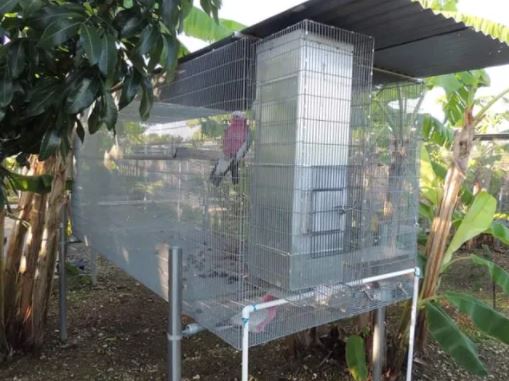
The species is well-suited for smaller enclosures, though it is recommended to keep only one pair per aviary.
| Feature | Specification |
| Ideal Aviary Size (Suspended) | 600mm (W) x 900mm (H) x 1800mm (D) |
| Nest Box Dimensions | 180mm x 180mm x 450mm (D) |
| Entrance Opening | 50mm |
| Nesting Material | 50mm layer of fine wood chips |
| Leg Band Size | 5.5mm (PASA Code D) |
Dietary Requirements
These birds are not selective eaters, but their diet must be managed to prevent spoilage:
- Primary Mix: Moistened micronized grains and leguminous seeds (e.g., Avi-Plus Complete Parrot Mix).
- Additives: Grated carrots are recommended.
- Restrictions: Fruit should not be mixed into the moist feed, as high moisture content leads to souring and mold.
- Dry Feed: Millet, manna, canary seed, and limited amounts of sprouted sunflower seeds.
Breeding and Development
The breeding cycle of the Green-Cheeked Conure is characterized by high yield and specific parental behaviors:
- Sexual Maturity: Usually attained at two years, though captive-bred generations frequently breed at one year.
- Clutch Size: Typically between five and nine eggs.
- Incubation: Lasts approximately 20 days; the hen is the sole incubator.
- Nestling Phase: Chicks remain in the nest for about five weeks. They require an additional three to four weeks with their parents to learn independent feeding.
- Risks:
- Males may occasionally attack or injure chicks.
- Older chicks remaining in the nest may inadvertently break or soil new eggs with defecation.
Genetic Mutations and Inheritance
The explosion of interest in the Green-Cheeked Conure is largely attributed to its varied genetic mutations. These mutations are categorized by their mode of inheritance.
Primary Mutations and Combinations
| Mutation | Inheritance Type | Characteristics |
| Turquoise (Blue) | Autosomal Recessive | The first mutation to appear; not a “true” blue. |
| Opaline (Yellow-sided) | Sex-linked | Once mistaken for a separate species (P. hypoxantha). |
| Cinnamon | Sex-linked | Can be combined with Opaline. |
| Pineapple | N/A (Combination) | A combination of Cinnamon and Opaline. |
| Suncheek | N/A (Combination) | A combination of Pineapple and Dilute. |
| Violet | Co-dominant | Emerges as Violet-green; most visible when combined with Turquoise. |
| Misty | Co-dominant | Displays a subtle effect, but promising in double-factor combinations. |
| Fallow | Recessive | Characterized by red eyes and a shift from grey/black pigments to light brown. |
Genetic Linkage and Crossover
A significant aspect of Green-Cheeked genetics is the linkage of certain sex-linked genes on the X chromosome.
- Opaline and Cinnamon: These genes are located relatively far apart on the chromosome, resulting in a 17% crossover rate.
- Lutino and Cinnamon: In contrast, these genes are situated close together, with a crossover rate of only 3%.
The Fallow Mutation
The Fallow mutation is often misunderstood. For a bird to be classified as a true Fallow, it must meet specific criteria:
- Recessive Inheritance: The trait must be passed recessively.
- Ocular Pigmentation: The eyes must remain red into adulthood.
- Pigment Shift: Grey and black pigments must change to light brown, while green and blue feathers shift to yellow-green and light blue, respectively.
Sustainability and the Future of Aviculture
The Green-Cheeked Conure plays a vital role in the sustainability of the South African avicultural industry. As more parrot species are added to the CITES 1 list, international trade becomes increasingly restricted.
Because Green-Cheeked Conures are not highly threatened in the wild, their color mutations achieve the status of “valuable birds” that can be traded internationally with fewer restrictions. The combination of their ease of breeding, low noise levels, and the constant development of new color combinations (such as the Violet-opaline or Misty Turquoise) ensures their long-term appeal and economic viability in the global market.
Green-Cheeked Conure Price Guide
The cost of a Green-Cheeked Conure varies drastically based on their specific feather genetics:
- Standard Green-Cheek Price: R1,500 – R2,500
- Pineapple & Cinnamon Mutations: R2,500 – R4,000
- Rare Turquoise & Crimson Mutations: R4,500+
(Note: Prices depend heavily on your local aviculture breeders and hand-rearing status.)