Breeding by parents at Loro Parque Fundación


Breeding by parents at Loro Parque Fundación
By: Rafael Zamora Padrón
Scientific Director
Loro Parque Fundación
At Loro Parque Fundación, where the largest living genetic reserve of parrots in the world takes place, the average annual reproduction results in about 1,000 chicks of the most diverse species. All with some degree of threat in nature. Throughout this year 2020 we have already exceeded a thousand births, which become a true safety net for each of the represented species.
Sometimes the incubation or growth of the chicks must be assisted by auxiliary techniques such as artificial incubation or hand-rearing, which implies longer subsequent socialization processes until the young parrots are completely independent. We are happy to share that, between last year and so far this year, more than 70% of the chicks that have been raised by their parents have been exceeded.
An achievement that makes us immensely happy since it is really important that the chicks develop with their parents. Especially when it comes to birds that can be reintroduced into the wild in order to repopulate certain species that are in danger of extinction. For this reason, it is vital that they discover, through their parents, the correct way to eat and communicate, in addition to learning the customs and behaviors of each species.
At Loro Parque and Loro Parque Fundación we carry out hand-raising, assisted by our technicians, with the most advanced technologies at all levels, including biosecurity. These tasks are carried out only under special circumstances and can also be applied in our projects in the wild, whenever it is necessary thanks to the experience and accumulated data.
In nature, the first attempts of the youngest couples do not result in the survival of the offspring, as they do not dominate the incubation and care behaviors of their little ones at one hundred percent. In controlled environments, these common losses can survive thanks to the advancement of protocols and new technologies. Sometimes is the only way to save one species.
Breeding by parents – Rearing by hand
Rearing by hand is always a challenge if we start from the point where it is clear that reaching the growth curve achieved by the parents, with their direct feeding, is usually always below than the formulation that is supplied to them in manual rearing. However, today neonate food formulas have evolved substantially and with many species optimal growth of young parrots is achieved. And it is clear that although the formula is very good, the human component of discipline, in hygiene and management methods, is the key for the process to develop successfully.
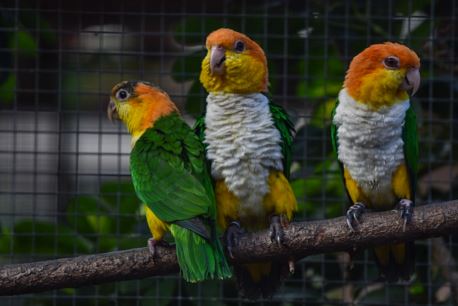
Breeding by parents – One of the species that usually present problems in hand rearing is the Caiques group. The position of the chicks, so that they do not regurgitate and can choke on food, with the additions that the rearing pap requires, so that growth is not extremely slow, is one of the points to overcome with these species. Also the imprint that can be very marked in the caiques, requires a prolonged period of socialization with juvenile specimens from past seasons, which will be the only way that the hand-reared will behave well in the future with respect to their breeding partners. For this reason, when parents successfully raise their little ones for us it has many added values.
Breeding by parents – Many parrot lovers think……
Many parrot lovers think that if a parrot acquired as a pet is not raised by hand, it will not be as docile and affectionate as one that is. Far from reality, a parrot raised by its parents can be even more affectionate towards humans, since it recognizes its position as a bird, recognizes itself as a parrot and does not break the limits of absolute dependence that a hand-reared parrot can express if the previous method of care was not appropriate. A hand reared parrot without the correct management, truly believes that he is an equal to his owners, becoming on many occasions a little tyrant.
Breeding by parents – Both modalities are compatible with the psychological health of the exemplars. If a hand-reared parrot does not socialize in its juvenile stage with its species, it will have a hard time adapting to new circumstances and a domestic life. For this reason, it must have a period of flight and relationship with its peers until it is self recognized as a parrot and its own species.
A parrot raised by its parents
A parrot raised by its parents, whose destiny is not primarily reproduction, will have to socialize with humans from a young age and will become a great companion who will rarely show behavioral problems.
At this time of the end of the year at Loro Parque Fundación, while several chicks of the Australian black cockatoos are born, some notable specimens are already becoming independent, such as 4 Lear’s macaws (Anodorhynchus leari) that are currently in the beginning of development of his flying skills. Or a palm cockatoo that shyly begins to relate to solid food. All, exciting processes to observe day by day and modify everything that is necessary. Because nature is always changing and we must be attentive to listen to it, acting accordingly.
You might also be interested in this post:
Parrot Fostering in Loro Parque Fundación
To learn more about the amazing work at Loro Parque Fundación, you can visit their website: